7 Ways Virtual Dissection Labs Can Benefit Your Program
If you teach anatomy, you’ve seen how expectations around learning have shifted. Virtual dissection labs continue to emerge as a powerful complement or modern alternative to traditional cadaver labs.
With advances in 3D visualization, interactive software, and remote access, these tools are becoming a go-to option for programs looking to adapt to changing educational needs. Whether you’re supporting hybrid learners, managing limited lab space, or simply looking for ways to reinforce complex concepts, virtual dissection labs offer flexibility without sacrificing rigor.
1. Enhanced Visualization
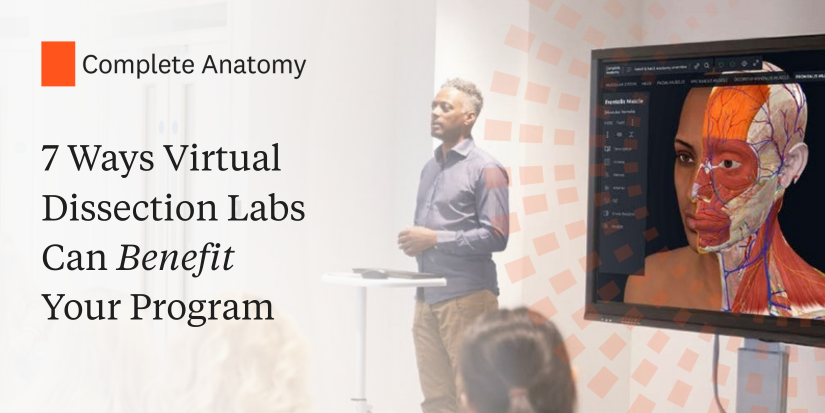
Virtual dissection labs give you incredibly detailed, interactive 3D models that students can rotate, zoom, and manipulate in ways that aren’t possible with cadavers alone. You can isolate specific structures, layer systems, or view organs from multiple angles, which makes understanding spatial relationships far easier.
For complex regions—like the cranial nerves, brachial plexus, or heart chambers—students explore intricate details at their own pace. They can easily revisit areas they find tricky without worrying about specimen limitations.
Platforms like Complete Anatomy take this a step further with micromodels, letting you examine tissue layers, cellular structures, or vascular networks while still seeing how they fit into the bigger anatomical picture. This contextual view reinforces connections between microscopic and macroscopic anatomy, improving retention and comprehension. Plus, interactive features like quizzes, labeling, and guided dissections provide a more engaging experience than static images or textbooks, helping students actively process and internalize the material.
2. Risk-Free Practice
Virtual dissection labs let you explore anatomy and practice procedures without worrying about health hazards, exposure to chemicals, or damaging delicate specimens. Students can repeat dissections, isolate structures, or simulate complex procedures as many times as needed, which builds confidence and competence before stepping into a physical lab. This kind of repeated practice is especially valuable for beginners, who often feel anxious in their first cadaver sessions.
Without the pressure of irreversible mistakes, students are more willing to experiment and ask questions. They can focus on learning rather than worrying about making errors or harming a specimen. Over time, this low-stress environment encourages curiosity and active learning, which are key for deeper understanding and long-term retention.
Virtual labs also create a safe space for trying advanced techniques or revisiting challenging topics. Students can practice dissections, review structures, or reinforce clinical correlations without the limitations of traditional labs. This flexibility ensures that every student has the opportunity to learn at their own pace while developing anatomical skills.
3. Increased Accessibility
Virtual dissection labs offer greater flexibility in accessibility compared to traditional cadaver labs. Complete Anatomy can be accessed on any internet-enabled device at anytime, making it ideal for remote, hybrid, or asynchronous learning environments. Students no longer need to be physically present in a lab to engage deeply with anatomical structures, which is especially helpful for programs with limited lab space or students balancing work, family, or other commitments. This flexibility allows learners to study at their own pace and revisit challenging concepts whenever they need extra practice.
Accessibility also extends to students with diverse learning needs and preferences. Features like adjustable views, zoom functions, alternative labeling methods, and customizable pacing make virtual labs more inclusive than traditional cadaver labs.
By breaking down geographic, logistical, and physical limitations, virtual dissection labs give every student more opportunities to succeed. Whether your program has a small number of cadavers or large enrollment, these tools ensure all learners can access high-quality, interactive anatomy experiences on equal footing.
4. Practical and Logistical Benefits
Virtual dissection labs remove many of the logistical challenges that come with traditional cadaver labs. There’s no need for specimen storage, refrigeration, or chemical preservation, and you don’t have to worry about setting up or cleaning up a messy lab space. This simplifies your workflow, freeing up time and resources so you can focus on teaching rather than managing lab logistics.
Scheduling becomes far more flexible, too. You can accommodate large groups of students without worrying about overcrowding, and multiple learners can access the same content simultaneously, whether in-person or remotely. This flexibility makes it easier to integrate anatomy sessions into an already packed curriculum without the usual bottlenecks of limited lab space or specimen availability.
Updates and curriculum integration can also be more seamless. Virtual labs allow you to roll out updated content, revise lessons, or incorporate clinical correlations instantly, keeping learning materials current without additional cost or setup. You can align the lab experience directly with your course objectives, ensuring students are practicing relevant skills and mastering concepts that match your program’s goals.
5. Cost-Effectiveness
Maintaining traditional cadaver labs can be expensive, with costs that include specimen procurement, storage, preservation chemicals, lab space, and staff oversight. Virtual dissection labs significantly reduce many of these expenses, while still providing students with high-quality, interactive anatomical experiences. Over time, the savings on facilities, equipment, and staff time can be substantial, freeing up resources for other program priorities.
Virtual labs also scale much more easily than physical labs. When class sizes increase or remote learners join, the need for additional space and specimens, which are common challenges with cadaver labs, is minimized. This makes virtual labs particularly attractive for programs looking to grow without proportionally increasing expenses.
Beyond immediate cost savings, virtual labs reduce indirect financial burdens as well. Fewer materials to oversee, less maintenance, and minimal setup time translate into long-term efficiencies, allowing you and your team to focus more on teaching and less on coordination. Investing in virtual labs can make high-quality anatomy education more financially sustainable and scalable for your program.
6. Ethical and Sustainable
Virtual dissection labs help address long-standing ethical considerations around cadaver use by reducing reliance on donated human specimens. In countries like the United States, where medical student enrollment continues to grow, the demand for body donations is increasing. This underscores the need for intentional, forward-looking educational solutions. While cadaver labs remain valuable, not every program has equal access to donations.
From a sustainability standpoint, virtual labs significantly reduce the need for ongoing specimen procurement, preservation chemicals, and specialized storage facilities. This lowers environmental impact while also easing the logistical burden on institutions that manage donations. Over time, using virtual dissection as a supplement or alternative supports a more sustainable anatomy program without compromising educational quality.
Virtual labs also make it easier to balance ethical responsibility with instructional consistency. You can deliver the same high-quality anatomical experience year after year, without depending on specimen availability or condition. This approach allows you to teach anatomy thoughtfully while adapting to evolving ethical standards and institutional priorities.
7. Standardized, Consistent, and Time-Efficient
One of the biggest advantages of virtual dissection labs is consistency. Every student sees the same high-quality anatomical structures, eliminating the variability that naturally exists between cadaver specimens.
This makes it easier for you to teach core concepts with confidence, knowing everyone is working from the same reference point. You don’t have to adjust explanations based on specimen condition or anatomy differences, which can derail lab time.
Virtual labs also streamline preparation because no setup, cleanup, or specimen management is required. You can jump straight into teaching, demonstrations, or guided exploration. Students can study beforehand, making sure everyone has around the same baseline of knowledge before moving into a dissection lab where there’s higher risk, limited time, and limited space. Lab sessions become more focused, efficient, and aligned with learning objectives.
Over the course of a term, the time saved adds up, giving you more flexibility to reinforce challenging topics, integrate clinical context, or support students who need extra guidance.
Conclusion
Virtual dissection labs aren’t about replacing everything that works in anatomy education. They’re about giving you more flexibility, consistency, and control over how students learn.
Whether you use them as a supplement to cadaver labs or as a primary teaching tool, they allow you to reinforce complex concepts, meet diverse learner needs, and adapt to changing program demands without sacrificing rigor.
Ultimately, virtual dissection labs give you options. They let you design anatomy experiences that fit your curriculum, your students, and your institutional goals—without being limited by space, specimens, or schedules. When used thoughtfully, they don’t just modernize your program; they strengthen it.
Key Takeaways
- Interactive 3D visualization enhances students’ understanding of complex anatomical structures and spatial relationships.
- Risk-free, repeatable practice builds confidence and competence without the pressure of irreversible mistakes.
- Anytime, anywhere access increases flexibility and inclusivity for diverse learning needs and schedules.
- Reduced logistical demands streamline instruction and make curriculum updates easier to implement.
- Virtual labs offer a cost-effective, scalable alternative to traditional cadaver-based instruction.
- Ethical and sustainable design supports responsible anatomy education while maintaining high instructional quality.
- Standardized, time-efficient experiences ensure consistent learning outcomes for all students.
Resources
https://www.aamc.org/news/us-medical-schools-enroll-record-number-students-2025


