
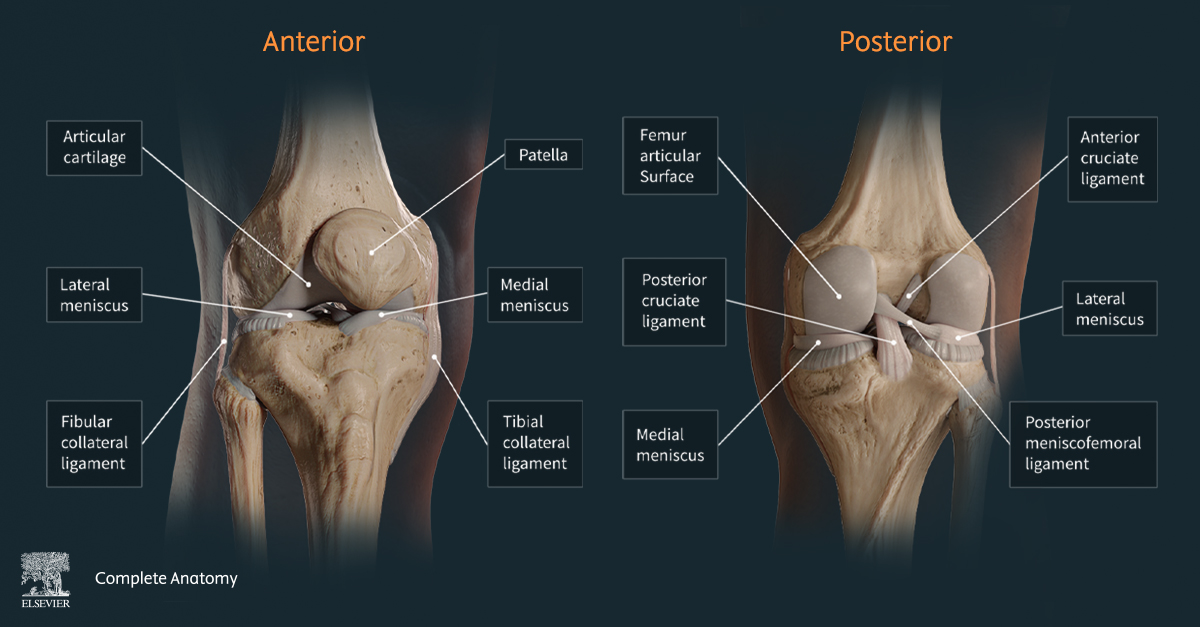
The knee joint is the largest joint in the human body. It acts as a hinge joint formed by the articulation of the femur, tibia, and patella. We use our knees to bend, straighten, and slightly rotate our legs as is essential for everyday walking, running, or jumping.
The knee has four main ligaments. These ligaments connect the femur to the tibia.
Anterior cruciate ligament (ACL): This ligament is in the centre of the knee and controls rotation and forward movement of the tibia.
Posterior cruciate ligament (PCL): This ligament is also located in the centre of the knee and controls backward movement of the tibia.
Medial collateral ligament (MCL) or tibial collateral ligament: Is located on the medial side of the knee and gives stability to the inner knee.
Lateral collateral ligament (LCL) or fibular ligament: This ligament is on the lateral side of the knee and gives stability to the outer knee.
These ligaments can often be injured, usually due to sports injury. Activities such as skiing, basketball, and football are sports that have a higher risk for ACL injuries. The ACL is the most common knee ligament to injure. It is often torn or stretched in a sudden twisting motion. On the other hand, injuries can happen to the collateral ligaments as well. The MCL is more commonly injured that the LCL due to stretching or tearing caused by a blow to the outer side of the knee. Treatment for such injuries may include muscle-strengthening exercises, protective knee braces when exercising, ice pack application to reduce swelling, and/or surgery.


